RepoGrammar
Repository conventions for coding agents.
Documentation · Quickstart · Changelog · Contributing
RepoGrammar indexes repeated implementations in your repository and gives coding
agents a source-backed read plan: examples of how this codebase implements a
route, fixture, model, or data-access role, with the evidence behind each match.
When the evidence is insufficient, it returns UNKNOWN with a recovery action.
It runs locally and exposes a pattern-first CLI and one read-only MCP tool. There are no LLM calls, API keys, embeddings, or cloud services in the analysis path. Python 3.10+ is required for the bundled Python analyzer.
Verified GitHub release baseline: 0.5.0. For current channel versions and their verification, see the publication evidence.
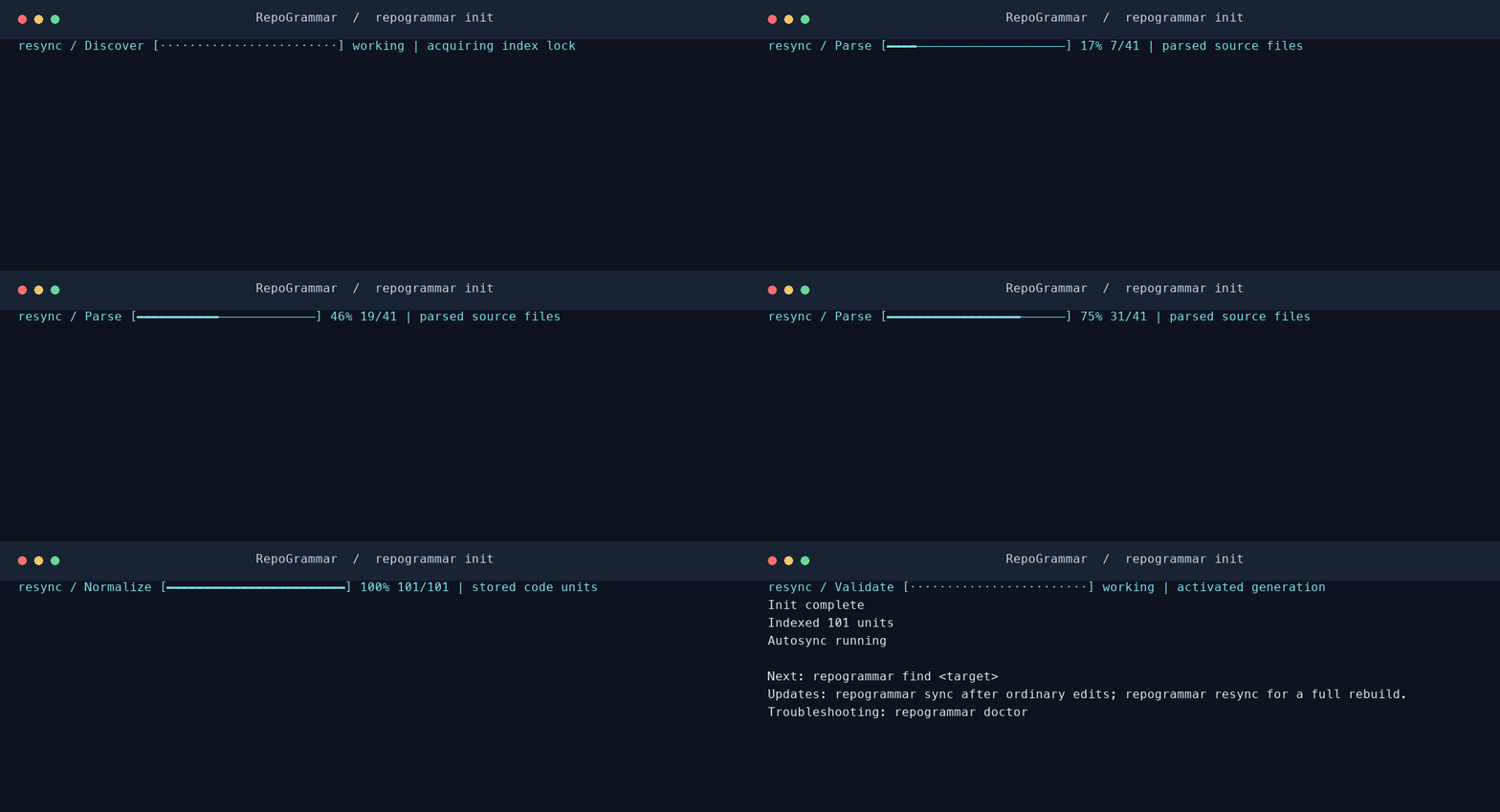
Recorded from a real CLI run on a fixture repository; playback is slowed for readability.
Quick start
Choose an installation route, then initialize your project → connect your agent → verify. Releases that include the one-command bootstrap can combine these steps.
Full Python project setup requires Python 3.10+ within 3.x, Git, Bash,
curl, tar, and gzip. CLI-only installation does not require Python.
Supported platforms are macOS arm64/x86_64, Linux x86_64 with glibc 2.35+, and
Linux arm64 with glibc 2.39+. The native installer does not require Rust, Cargo,
Node.js, Docker, or API keys. The npm launcher requires Node.js 18 or newer.
1. Install the CLI
Choose npm or the pinned native installer below; you do not need both.
npm
npm install -g @sioyooo/repogrammar &&
repogrammar version
The launcher downloads and verifies the matching native release on first use.
It does not initialize a project or configure an agent. Continue with step 2.
To pin a version, append @<version> to the package name; that version must
have matching GitHub native assets.
Pinned native baseline: 0.5.0
This single block downloads the pinned installer, verifies its checksum, and installs the CLI. It does not alter coding-agent settings or index a repository. For an existing installation, review the update and PATH behavior before rerunning the installer.
(
set -eu
install_tmp="$(mktemp -d)" || exit 1
trap 'rm -rf "$install_tmp"' EXIT
cd "$install_tmp" || exit 1
curl -fsSLO https://github.com/SioYooo/RepoGrammar/releases/download/v0.5.0/install.sh || exit 1
curl -fsSLO https://github.com/SioYooo/RepoGrammar/releases/download/v0.5.0/install.sh.sha256 || exit 1
if command -v sha256sum >/dev/null 2>&1; then
  sha256sum -c install.sh.sha256 || exit 1
else
  shasum -a 256 -c install.sh.sha256 || exit 1
fi
bash install.sh --version v0.5.0 --install-cli-only --yes
) &&
export PATH="$HOME/.local/bin:$PATH" &&
repogrammar version
Add the export PATH line to ~/.zshrc or ~/.bashrc once to keep the command
available in new terminals. Expected version: 0.5.0.
2. Index your project
From your project’s directory:
repogrammar init
init builds the current project’s index and starts background
updates. There is no global repository scanner. Run init once in each project.
The explicit form repogrammar init --project "$PWD" --yes does the same thing;
use --no-autosync for CI or a one-shot index.
3. Connect your coding agent (optional)
repogrammar install --target auto --scope global --yes --no-telemetry
Restart the coding-agent session after connecting. Choose a specific client with
--target codex, --target claude-code, or --target opencode.
4. Verify setup
From the initialized project:
command -v repogrammar
repogrammar version
repogrammar status
Check that the version and command path match the installation you chose.
If the index is unavailable or stale, run repogrammar doctor and follow its
recovery guidance. After
restarting your agent, confirm that repogrammar_context is available in its
MCP tools. Installing the CLI alone does not establish a working agent session.
One-command bootstrap
The 0.5.1 source includes --quickstart: review one plan, authorize it, then install
the CLI, connect detected supported agents, index the selected Git repository,
and start repository-local autosync. No agent is required for CLI/index setup.
After a successful quickstart, go straight to Verify setup;
the separate install, init and agent-connection steps are already handled.
Use an installer and matching binary that include the quickstart-v1 capability;
the pinned 0.5.0 baseline above does not. The
quickstart guide
records availability, verified commands, plan preview, noninteractive execution
and agent selection. The
publication checklist
records the artifact and installation gates for this flow.
| I want to… | Guide |
|---|---|
| Install, update, or troubleshoot | Quickstart |
| Connect Codex | Codex setup |
| Connect Claude Code | Claude Code setup |
| Connect opencode | opencode setup |
| See every command | Run repogrammar help --all or read the CLI reference |
| Understand evidence and limits | Limitations |
| Remove the installation | Uninstall guide |
When should I index again?
| Situation | Action |
|---|---|
| First time in a project | repogrammar init |
| Normal edits while autosync is running | Nothing; updates run in the background |
| Autosync is stopped, or you want an immediate update | repogrammar sync |
| You need a full rebuild, or recovery guidance requests one | repogrammar resync |
| You are unsure whether the index is ready | repogrammar status; use repogrammar doctor for recovery |
index remains available for compatibility. Use init to start, sync for
ordinary changes, and resync to rebuild. Do not repeatedly run init after
normal edits.
Usage
Find examples for an exact repository location:
repogrammar find "path/to/routes.py:7" --project "$PWD" --mode compact
repogrammar families --project "$PWD"
repogrammar sync --project "$PWD"
Start with an exact path or symbol when available. Framework-qualified queries
such as FastAPI route are also supported. See the CLI reference
for the complete commands and the MCP contract
for coding-agent integration.
Background updates
init starts a daemon for that repository. On macOS and Linux, native file
notifications coalesce edits before a sync. Idle native operation reconciles
metadata periodically instead of rescanning the tree every second. Git-ignored
untracked directories are pruned before fingerprint traversal, while tracked
files and ignore exceptions remain visible.
If native watching fails, autosync logs the fallback and polls with bounded
idle backoff. Failed syncs retry with bounded backoff even without another edit.
File notifications are hints; explicit sync and query-time hashes remain the
freshness authority. These changes reduce background work; no battery-life
percentage is claimed.
repogrammar autosync status --project "$PWD"
repogrammar autosync stop --project "$PWD"
repogrammar autosync start --project "$PWD"
For CI or one-shot analysis, initialize with --no-autosync. See the
autosync contract for intervals and recovery.
How it works
repository → local index → pattern families → examples + bounded read plan
                                └──────────→ UNKNOWN + recovery action
- Repository conventions: find compatible implementations and their exceptions.
- Verifiable context: every result carries provenance and freshness checks.
- Incremental updates: native filesystem events wake autosync; changes use the existing incremental indexer. Periodic reconciliation and polling fallback handle unavailable watchers.
- Agent integration: connect Codex, Claude Code, or opencode through MCP.
How does it differ from other code tools?
| Tool or mechanism | What it contributes | Where RepoGrammar fits |
|---|---|---|
| grep / text search | Exact strings and source locations | Qualifies repeated implementation-family context and the source reads still required |
| Semantic search / RAG | Retrieves material relevant to a query; a generation layer may use it | Provides a bounded local evidence contract, without embeddings or generation in its analysis path |
| CodeGraph / symbol graphs | Declarations, references, and call paths | Complements graph navigation with family selection, provenance, and abstention |
| Static analyzers | Checks under a tool’s specified semantic model | Reports bounded convention evidence and static alignment; it is not a sound whole-program analyzer |
These are mechanism comparisons, not benchmark or superiority claims. Static alignment is not proof of runtime equivalence. The FastAPI/pytest fixture walkthrough shows a read plan, optional source spans, and negative cases you can reproduce.
What do UNKNOWN and a bounded read plan mean?
UNKNOWN means the requested claim lacks sufficient qualifying evidence. Its
typed reason and recovery action tell the agent what remains unresolved; it
does not mean the repository is incorrect. PARTIAL_CONTEXT can provide local
metadata without selecting a proven family. A bounded read plan names a limited
set of source locations and remaining reading obligations. Read the required
source before editing; the plan does not replace that obligation. See the
MCP contract
and UNKNOWN policy.
Does repository code leave my machine?
RepoGrammar’s analysis runs locally and makes no LLM, embedding, or cloud calls. MCP responses contain metadata by default; source spans require explicit opt-in. The coding agent receiving that response has its own data-handling policy and may send metadata or requested source to its provider. Local analysis is not a privacy guarantee for the entire agent session. Anonymous telemetry is off by default and excludes source and paths; explicit upload is separate. See the telemetry contract for local diagnostics and consent boundaries.
Scope and limitations
The official language focus is Python: FastAPI, pytest, Pydantic, and SQLAlchemy. Other languages have bounded structural or dependency-inventory capabilities; these are not full language support. The strict Top-20 qualification program remains 0/20 complete. Read the language audit for the evidence and unresolved gates.
RepoGrammar is pre-1.0. It is not a sound whole-program analyzer, and neither a syntax match nor a dependency declaration proves behavior. Dynamic dispatch, unsupported frameworks, stale indexes, and incomplete semantics can result in abstention. Read known limitations before relying on a result.
Public binary targets are macOS arm64/x86_64 and glibc Linux arm64/x86_64. Windows and musl Linux are not supported installation targets.
Use ordinary source inspection when a repository has few repeated patterns,
your framework is outside the bounded scope, or an answer remains UNKNOWN.
Use runtime tests or a suitable semantic analyzer when the question requires
behavioral correctness, security assurance, or whole-program proof.
Development
cargo build --locked
cargo test --workspace --all-features
Read CONTRIBUTING.md and the testing policy for the full checks. Architecture and specifications live in docs/. Report bugs through GitHub Issues; report security issues according to SECURITY.md.
License
MIT.